

At FuelMaxx, we’re always researching, testing, and innovating—but at the end of the day, the only data that truly matters is how our FMD performs for our customers. Below, you’ll find sampling of reports we have created for a diverse group of customers. It is important to note that all testing and data collection were carried out by the customers’ internal teams, ensuring complete transparency and credibility.
REFERENCES AVAILABLE BY REQUEST
FMD FUEL SAVING REPORT MARINE ENGINE
1. Introduction:
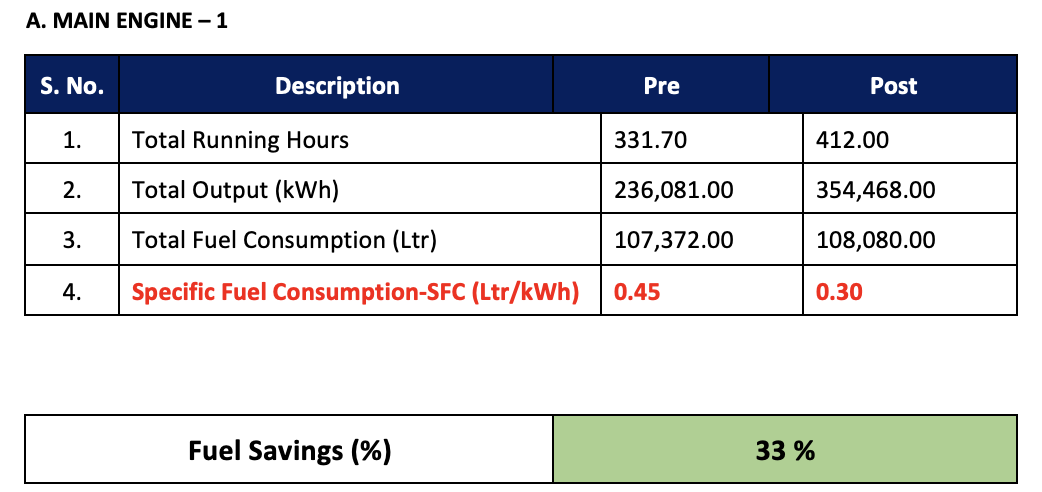
This report documents the fuel-saving benefits achieved by integrating the FMD on two key engines aboard the BARGE; Main Engine - 1 (propulsion) and Auxiliary Engine - 3 (power generation). By comparing pre- and post-installation data over significant operating periods, the analysis confirms improvements in Specific Fuel Consumption (SFC) i.e. Ltr/kWh and overall combustion efficiency.
2. Objective:
To evaluate the fuel-saving potential of the FMD device under real-world marine operating conditions by monitoring and comparing engine performance before and after FMD integration.
3. Equipment Details:
MAIN ENGINE - 1
a. Make: HIMSEN
b. Rated Output: 1600 KW @ 900 rpm
c. Cylinder configuration: In – line
d. Operation: To operate propeller
AUXILIARY ENGINE - 3
a. Make/Model: CUMMINS/QSM11-DM
b. Rated Output: 317 KW @ 1800 rpm
c. Cylinder configuration: In- Line
d. Operation: Auxiliary Engine
4. Data Collection Methodology:
A. Main Engine - 1:
During both BOSP and EOSP operations, the following parameters were systematically recorded and maintained by the engineering staff onboard the barge:
i) Fuel Consumption (Ltr): Measured using the fuel flow meter installed by CLIENT
ii) Engine Operating hours: Captured via CLIENT’s onboard meter
iii) kWh Output: Monitored using the onboard meter installed by CLIENT
B. Auxiliary Engine – 3:
For Auxiliary Engine 3, the same parameters were monitored and recorded by the BARGE staff during BOSP and EOSP operations with instrumentation as follows:
i) Fuel Consumption in Ltr: Measured using the fuel flow meter installed by CLIENT
ii) Engine Operating hours: Captured via CLIENT’s onboard meter
iii) kWh Output: Logged via the electrical data logger installed by Ai360LLC
5. Calculation Methodology:
Specific Fuel Consumption (SFC) was used as the key performance indicator for energy efficiency, calculated as:
SFC (L/kWh) = Total Fuel Consumed (Litres) / Total Energy Output (kWh)
6. FMD Installation:

7. Results Summary:
8. Conclusion:
The results clearly demonstrate that the FMD improves fuel efficiency across both main and auxiliary engine applications:
· Main Engine -1:33% fuel efficiency gain
· Auxiliary Engine – 3: 8.33% fuel efficiency gain
9. Recommendations:
· Consider FMD deployment on remaining engines aboard the vessel for cumulative savings.
· Evaluate potential integration across other vessels in the fleet to replicate benefits.